






At Greentown Labs, we’re working to catalyze climatetech innovation that addresses the world’s most urgent resiliency and industrial challenges. At the latest Greentown x Lux Research Forum, we explored how industries today are facing a growing water paradox: reliable access to clean water is becoming increasingly constrained by climate volatility, drought, and rising demand from energy, manufacturing, and data centers, even as those same industries generate vast volumes of wastewater that are still largely treated as a liability rather than a resource.
A wide swath of experts explored how these challenges are unfolding today, and what they mean for communities, industry, and innovation in the years ahead. While water is foundational to modern life and economic growth, it is far more limited than often assumed: only 3 percent of Earth’s water is freshwater, and just 30 percent of that is accessible through surface and groundwater. The energy sector alone uses roughly 370B cubic meters of freshwater each year—about 10 percent of global consumption. At the same time, nearly a quarter of the world’s population faces water scarcity, underscoring a critical truth: the world’s energy and industrial challenges also represent a water challenge. The challenge, forum participants emphasized, is not simply absolute scarcity, but increasing mismatch: where water is available, at what quality, and with what reliability—versus where economic activity depends on it.
For industry, this mismatch is becoming a material risk. Climate-driven variability, aging infrastructure, seawater intrusion, and tightening regulations are undermining water reliability in many regions, even where water has historically been abundant. Water risk is no longer a background operational issue; it is increasingly shaping capital allocation, site selection, permitting timelines, and long-term resilience strategies across sectors.
Against this backdrop, the forum explored how companies are reassessing water as a strategic resource—and where innovation is beginning to close the gap. Discussions focused on how risk, rather than water price alone, is driving investment decisions; why certain sectors move first; and where startups can meaningfully accelerate adoption through new technologies and business models.
We were thrilled to have leaders from Chevron, Coflux Purification, Dow, Equinor, New Climate Ventures, Onvector, Rice WaTER Institute, SkyH2O, SLB, and Stantec join The Forum to share their perspectives on this challenge and the opportunity it presents.
Key Themes and Takeaways
Water Pricing is Fundamentally Broken
Participants agreed that water pricing is fundamentally misaligned with its true value: markets are hyper‑local, fragmented, and heavily political, with inconsistent water rights regimes and strong pressure on municipalities to keep costs low for citizens, even when infrastructure is aging and treatment requirements are rising. As a result, water is chronically underpriced in most industrial and municipal budgets, treated as a cheap utility line item rather than a strategic resource.
As long as water continues to be treated as a commodity, innovation will be forced to depend on crises or regulation, with significant cost reduction being the main reason for companies to invest in new technologies. This creates a disconnect where companies recognize water as mission‑critical, but still struggle to justify investments.
Risk Assessment is Now Driving Capital Allocation
Across sectors, risk assessment is increasingly shaping new water investments. Rather than focusing solely on the nominal cost of water, companies are prioritizing the risks of production losses, permitting delays, tighter regulations, and damage to community trust or customer relationships. As droughts, floods, and seawater intrusion undermine supply reliability, large industrials and data-intensive users are elevating water risk to a core resilience concern. Accordingly, capital expenditures are justified when they materially reduce the risk of water-related downtime, production curtailment, or reputational exposure for operators.
High-Value and High-Risk Operations Move First
Forum participants noted that water technology adoption varies sharply by industry. Adoption is driven less by water costs than by scientific sophistication, regulatory exposure, and sensitivity to quality, sustainability, and reputational risks. Industries with high water dependence and significant downside risk are usually the first movers.
Food and beverage and semiconductor companies are natural first movers, with a strong willingness to invest in water treatment and reuse compared with commodity producers. For these sectors, water quality is mission-critical, directly affecting yield, uptime, and product integrity. By contrast, chemicals and oil and gas adopt more cautiously, prioritizing regulatory compliance and lowest-cost solutions. Opportunities for startups typically arise only when they can integrate with established service providers or deliver step-change economics at strategically important sites.
Data-center operators are beginning to invest in high-risk geographies where water scarcity threatens uptime, permitting, or community acceptance, even though water is a small part of operating costs. Buyers are highly risk-averse, favoring proven technologies, strong guarantees, and established partners, and they act only when solutions clearly enhance resilience, uptime, or regulatory/community compliance—not merely reduce costs.
Municipalities are politically constrained, slow to procure, and focused on affordability, making them unlikely early adopters. Likewise, smaller or low-margin sectors have limited capacity to invest beyond regulatory minimums and proven, low-cost solutions.
Where Startups Can Win—or Struggle
New water technologies occupy a space with clear opportunity but significant friction. Tightening regulations, rising local scarcity, and growing resilience concerns are expanding the addressable market, yet adoption is often constrained. Risk-averse end-users prioritize mission-critical reliability, treat water only to regulatory minimums, face long and uncertain pilot cycles, and increasingly rely on large service providers which act as de facto gatekeepers.
Business-model innovation is emerging to navigate these challenges. Approaches such as water-as-a-service, performance-based contracts, asset-rich service platforms, and joint-venture “utility spin-outs” from large industrials help overcome capex and operational hurdles. For these models to scale, however, technologies must deliver step-change cost or productivity gains, integrate seamlessly into existing risk frameworks, and align incentives across asset owners, operators, and offtakers.
Across sectors, tightening discharge standards and ecosystem concerns are making wastewater management central to both ecological and economic strategy. Specialized operators now own and operate treatment assets, absorb technical and operational risk, and deliver treated water or guaranteed compliance outcomes back to industrial clients—demonstrating how innovative business models can unlock adoption even in highly risk-averse environments.
Startup Opportunity Areas
Industrial Reuse + Discharge‑Side Innovation
The biggest industrial water innovation opportunities lie on the wastewater and discharge side. Real challenges include highly contaminated, concentrated, or variable streams. Startups can create value by increasing cycles of concentration, reducing disposal volumes, cutting treatment complexity, and managing salts, metals, and organics. Solutions that improve resilience, regulatory headroom, and total lifecycle cost are most attractive, but adoption depends on proven performance, risk mitigation, and seamless integration into existing plants and service provider models.
Greentown members and alumni innovating in this or adjacent areas include:
- Aquasaic
- Circular Materials
- Harmony Desalting
- Micronic Technologies
- Onvector
- Pure Blue Tech
- TDS Select
- ZwitterCo
Data‑Center Water Resilience
Hyperscale and AI data centers in water-stressed regions are driving demand for cooling-linked water solutions. Startups can target closed-loop or alternative cooling, on-site treatment and reuse of municipal or impaired sources, and smart software to co-optimize water and energy.
Adoption is constrained by site structure and risk: buyers rely on cities, EPCs, or large engineers, and prefer proven technologies, strong guarantees, or water-as-a-service models, making seamless integration and low-risk deployment essential for success.
Greentown members and alumni innovating in this or adjacent areas include:
Decentralized Solutions
Decentralized water solutions represent a major long-term opportunity in underserved markets, where roughly 3.5B people still lack basic sanitation. This gap creates space for modular, small-scale systems that can leapfrog centralized pipes, much like mobile phones bypassed landlines. Forum participants highlighted off-grid and near-grid technologies—including compact treatment units, waste-to-resource systems, and atmospheric water generation—as promising fits where centralized networks are economically or politically infeasible. For adoption at scale, however, these solutions must be exceptionally robust, low-maintenance, and operable with minimal skilled labor in regions already constrained by shortages of plumbers, welders, and technicians.
Greentown members and alumni innovating in this or adjacent areas include:
Monitoring, Control, and Optimization
Monitoring, control, and optimization emerged as critical enabling layers rather than headline technologies, playing an essential role in de-risking adoption and reducing operating costs in complex industrial water systems. As industries increasingly spin out utility functions or outsource operations to large service providers, operators need better sensing, analytics, and automation to run multi-step treatment trains reliably, prevent fouling and downtime, and extend asset life. Startups that deliver robust monitoring, predictive maintenance, and control platforms that integrate cleanly with existing environments are well positioned.
Greentown members and alumni innovating in this or adjacent areas include:
Conclusion
The discussion underscored a clear shift: water has moved from an assumed input to a defining constraint for industrial resilience.
As localized scarcity, regulatory pressure, and climate volatility intensify, the companies and communities that succeed will be those that treat water as a core risk and opportunity. From wastewater reuse to decentralized systems and smarter monitoring, innovation is already reshaping how water is sourced, managed, and valued. The challenge ahead is not whether solutions exist, but whether industry, policymakers, and innovators move quickly enough to deploy them at scale.
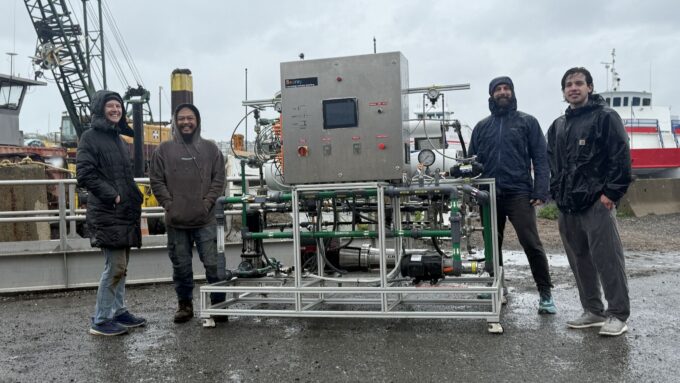
Photo: Harmony Desalting