






Innovation doesn’t happen by accident—it’s built. How corporations structure, staff, fund, and measure innovation determines whether bold ideas thrive or get stuck in corporate inertia.
Yet the mechanics behind innovation are often a black box. There’s no one-size-fits-all model, and few companies share how they actually make innovation work—or why it sometimes fails.
That’s why I’ve launched the Leaders in Innovation Series. These monthly conversations from Greentown Labs feature executives from some of the world’s leading companies, offering a behind-the-scenes look at how innovation is designed and sustained.
The goal? To uncover what really works—and what doesn’t—when it comes to turning ideas into impact.
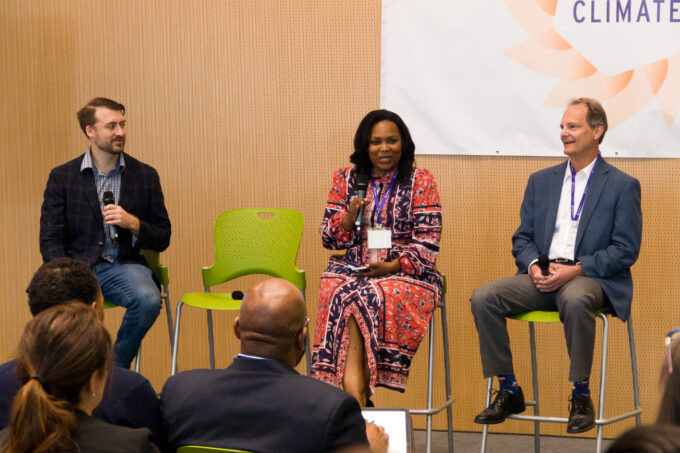
I first met Akilah LeBlanc at a summit in Lisbon two years ago. By then, she had already carved out a reputation inside Shell as a senior leader with real influence. Akilah has worked at Shell for over three decades, across nine different roles. When she started in 1995, she was part of the finance team in the pipeline organization; since 2020, she has helmed Shell’s efforts to collaborate with startups, researchers, and entrepreneurs on breakthrough technologies.
Under Akilah’s leadership, Shell’s innovation programs have gained real momentum. In 2024, she helped usher in a new phase of the Shell GameChanger Accelerator Powered by NREL (GCxN). The expanded agreement allowed the program to serve more startups than ever before, while adding features like strategic awards and a global network of entrepreneurial support organizations. The results are impressive: cohort companies have raised more than $942 million to date, hired 486 new employees since joining the program (a 260% increase since 2022), and advanced their average technology readiness level from 3.9 to 6.5 in just two years.

What makes Akilah such an effective and respected leader, I think, is that she treats innovation as both an economic necessity and a human endeavor — a space where technology, policy, and markets meet, but where people always remain at the center. When we met again earlier this year and I learned more about her background and her work at Shell, it became clear that her leadership isn’t just about shaping corporate strategies but also shaping the conditions where innovation can actually reach the world.
1. Understanding systems matters more for innovation
Akilah’s background and upbringing laid the groundwork for her success as an innovation leader today. She grew up in Houston, in a community largely reliant upon manufacturing jobs, and where gained an early appreciation for how industries shape daily life. At the University of Tulsa, she pursued finance, which led to her initial roles in Shell’s accounting department. She spent three years on the internal audit team, where she crisscrossed the world visiting facilities and absorbing how health, safety, and community care were woven into operations. Later, she structured portfolio deals that forced her to balance financial models against real-world constraints.
Though she didn’t know it at the time, her non-traditional path from finance to innovation would offer her a critical and unique vantage point: a keen instinct for value creation, a front-row view of global operations, and, eventually, a place on Shell’s global strategy team at a pivotal time — when the Paris Accord reshaped the climate landscape and ignited her commitment for climate justice.
This deep understanding of the energy transition — and its impact on society and global markets — honed her ability to connect complex, abstract ideas with practical realities. The hardest part of innovation, she realized, isn’t the technology itself, but aligning everything around it: the numbers, the policy environment, the socioeconomics, and the geopolitical realities. She recalled a former mentor at Shell who once told her, “Akilah, we have enough PhDs — we need someone who understands the social and global scale of the energy transition, and who can translate it into something we understand in this science-driven organization.”
This, Akilah believes, is a key trait of truly successful and outsized innovation leadership. Science may fuel the breakthroughs, but policy and markets determine whether they reach people. Leaders who can see across all these dimensions have the best chance of turning new ideas into lasting impact.
2. Innovation’s north star is its impact on the consumer
When I ask Akilah how Shell itself defines innovation, she doesn’t hesitate: “This sounds very general, but to me innovation is about creating something new that allows us to accomplish something we haven’t been able to do before.” It’s a deceptively simple definition that belies quite a bit of nuance. At Shell, innovation is a way of working that cuts across the entire enterprise, and it isn’t measured by patents or pilots alone. For Akilah, innovation only earns its name when it reaches the end user — i.e., when a new solution makes energy cleaner or more affordable or more accessible in daily life. It’s a view corroborated by Daniel Moczydlower of EmbraerX, who told me in our conversation earlier this year that “a breakthrough that never touches people isn’t innovation at all, just an idea that never left the lab.”
The way Akilah frames it, innovation isn’t a department or a side project but an ecosystem that stretches across the business. R&D obviously matters, but so do marketing, retail, operations, policy teams — all of them have a role in whether a new technology scales. Shell tries to hardwire this into practice by embedding innovation directly into strategy and long-term growth, rather than treating it as the kind of “branding exercise” that too often sidelines innovation efforts at other corporations.
3. Collaboration creates new markets; competition protects old ones
“Collaboration isn’t a ‘nice-to-have,’ but really the only path to making energy technologies affordable and available to consumers.” (Akilah LeBlanc)
When Akilah and I turn to the subject of climate innovation, one theme keeps surfacing: the transition is simply too vast for any single company to own. “There are many areas where corporations feel the need to win,” she tells me. “What’s important to me is changing the question from who wins? to how do we win together?”
Akilah argues that corporations that view competitors as adversaries end up stifling their own potential. Collaboration, by contrast, pulls in the strengths of startups, governments, academic labs, and other institutions — each filling gaps the others can’t. There is no silver-bullet technology that will solve the most complex and pressing global problems we face today, chief among them the climate crisis. Success demands a multi-pronged approach. Startups, for instance, contribute passion, urgency, a willingness to take risks. Academic institutions provide the rigor and research that can help shape the risk landscape of critical projects. And corporates like Shell offer infrastructure, resources, pathways to commercialization, and the ability to deploy solutions at scale.
Akilah has structured the innovation team at Shell around this kind of institutional symbiosis. TechWorks, for instance, is Shell’s innovation center in Boston that seeks to advance Shell’s short-term product development capabilities. Here, engineers apply systems thinking to prototype solutions in real time. Shell Ventures, on the other hand, backs promising companies through corporate venture funding. And Shell GameChanger scouts early-stage startups, giving them a platform to test bold ideas. None of these operate in silos. “Open innovation is a way of working,” Akilah says. “And it’s this mindset that keeps Shell connected to both its business units and its external partners.”
Her point immediately calls to mind the work of Henry Chesbrough, who coined the term “open innovation,” and Mariana Mazzucato, whose work has formed the basis of “mission-oriented collaboration.” Both insist that the most intractable challenges demand coalitions rather than siloed efforts. As a 2014 Harvard Business Review report on “The Collaboration Imperative” noted, countless corporate collaborations have failed under the weight of self-interest. The paradox is clear: everyone knows the energy transition requires collective action, but competitive reflexes are hard to unlearn.
What makes Akilah’s approach distinctive is how deeply it runs through Shell’s culture. Unlike the top-down approach of some corporates — where leaders dictate a path and everyone follows — Shell leans on consensus and diverse perspectives, bringing people along for the journey. “If the collaboration wins, we win as well,” she tells me. “If there’s a problem we solve with one of our partners, then Shell, the startups, and the consumers win together.” Corporations, Akilah says, should focus less on defending market share and more on creating entirely new markets, ones that don’t exist until collaboration makes them possible.
That, I think, is the real reframe here. Instead of fighting to dominate yesterday’s markets, can corporations pivot instead to co-create tomorrow’s?
4. Collaboration comes with its own tensions
Akilah speaks convincingly about collaboration as the key path to scale, but it’s worth noting that partnerships between corporates and startups are rarely frictionless. Scholars describe this as the “David-and-Goliath paradox,” where the very infrastructure that allows startups to scale quickly can also threaten to subsume them, pulling them away from their original mission. Research suggests that the pressure startups feel when partnering with large corporations is directly tied to the paradoxical tension of the relationship.
Still, it’s clear that Davids and Goliaths need each other. On the one hand, climate startups rarely scale without corporate partners; on the other, corporates stagnate without the disruptive technologies that startups bring. Both sides are disadvantaged without the other.
The question ultimately becomes: how do young companies use the advantages of corporate reach — distribution, capital, regulatory expertise, etc. — without losing the very scrappiness and mission that made them valuable partners in the first place? There’s no easy answer to this, of course. But based on my conversation with Akilah, perhaps the solution hinges on both Davids and Goliaths genuinely embodying a collaborative ethos in their partnerships, one that is proactively (not performatively) attuned to each other’s objectives and priorities.
5. Every long-term bet has to survive short-term pressure first
Of course, collaboration doesn’t only happen externally. Inside Shell, innovation teams also have to work with business units whose focus is the here and now — upstream leaders managing this year’s P&L, retail managers accountable for quarterly results. Their timelines rarely match the decades-long horizon of breakthrough technologies, and that mismatch creates friction (see point #3 in my conversation with Zafer Sahinoglu, Mitsubishi Electric’s VP of Innovation). For Akilah, that tension isn’t a barrier but another form of collaboration. Though it’s easier said than done, the push-pull can force teams to discover new ways to accelerate without losing sight of near-term needs. Startups, she notes, often help bridge the gap, offering a faster path to test ideas and drive costs toward parity with legacy offerings.
I’ve heard versions of this in my other interviews with innovation leaders. Anne Hardy of Saint-Gobain stressed building governance that stress-tests business models early, before the spend creeps up. Daniel Moczydlower of EmbraerX talked about creating “affordable-loss” lanes so Horizon-3 bets don’t get strangled by near-term KPIs. Akilah is operating in that same reality — two clocks ticking at once — and her team treats the clash as a constraint to design around rather than a reason to stall.
Looking ahead: collaboration as a test of will
If there’s a thread running through my conversation with Akilah, it’s that collaboration is a test of whether large institutions can truly change how they operate. Shell has the scale, startups have the agility, and academia has the depth. In theory, it all fits neatly. In practice, it demands that companies put aside the instinct to dominate and instead build markets no one can own alone.
That raises harder questions. What does it look like when collaboration isn’t just a pilot but a structural commitment? Can corporates really share risk and reward in a way that doesn’t tilt inevitably toward their balance sheets? And perhaps most urgently: if the energy transition depends on partnerships, who makes sure those partnerships stay aligned with the mission rather than the quarter?
Akilah’s optimism is grounded, but the test is still ahead. Collaboration may well be the defining requisite of this decade’s innovation leaders — not the ability to generate ideas, but to create the conditions where those ideas can survive the short-term pressures and reach the people they’re meant to serve. The question still stands whether enough companies are ready to take that leap.