





The Carbon to Value Initiative (C2V Initiative) is catalyzing the carbontech ecosystem with a dynamic startup accelerator and a slate of industry leaders capable of catapulting innovations into the market. The program wrapped up its fifth year this spring with a dive into the pilots, co-development agreements, offtake negotiations, and other collaborations formed over the past six months.
Led by the Urban Future Lab at NYU Tandon School of Engineering, Greentown Labs, and Fraunhofer USA, the C2V Initiative brings together innovative carbontech startups and a group of corporate and nonprofit leaders—known as the Carbontech Leadership Council (CLC)—who foster commercialization opportunities and identify avenues for technology validation, testing, and demonstration. CLC members that participated in Year 5 include Carbon180, Caterpillar Inc., CO₂ Value Europe, Energy Impact Partners, Evonik, Fluor, Johnson Matthey, L’Oréal, Shell, TotalEnergies, Veolia, W. L. Gore & Associates, and XPRIZE.
The initiative’s fifth cohort included 10 carbontech startups chosen through a highly competitive selection and deliberation process that drew a record 165 applications from 33 countries. Over the six-month accelerator, the startups collaborated with the CLC and received extensive mentorship to advance their commercialization efforts and de-risk their carbontech solutions; 29 advisors from the CLC were paired with the startups to offer hands-on expertise.
Since the C2V Initiative’s inception, the program has supported 45 startups that have raised over $700M in follow-on funding, leading to partnership engagements and 800+ business relationships, technology advancement, and industry growth. Thirteen startups have publicly announced partnerships with CLC members. Detailed results from Year 1, Year 2, Year 3, and Year 4 are available.
This year’s cohort carried that momentum onto its own balance sheets. Over the course of the program, the 10 startups raised more than $20M in disclosed new funding—led by Sora Fuel’s $14.6M Seed+ round and a subsequent strategic investment from Obayashi Corporation, Universal Matter’s roughly $5M, and Turnover Labs’ $2M seed first close—with Octavia Carbon closing additional funding, Rushnu securing non-dilutive support, and Arbon, Lite-1, and Mission Zero pressing ahead with active raises. Several startups achieved meaningful early commercial traction, from Cella’s $2.55M in contracted revenue with Frontier and Arbon’s roughly $1M in paid-pilot revenue to ICODOS’s progress toward a €4M-ARR clean-methanol offtake. Two cohort companies, Cella and Octavia Carbon, received catalytic funding from Tencent’s $30M CarbonX 2.0 Initiative.
Read about the Year 5 startups, their progress during the accelerator, and initial outcomes below, and check out session recordings from the C2V Initiative Year 5 Final Showcase here!
As always, this is just a fraction of the total outcomes that we expect from the program, which can sometimes take months or years of collaboration to bring to fruition—and often details are covered by non-disclosure agreements in the near-term.
Applications are open for Year 6 of the C2V Initiative through August 2026; interested startups can learn more and apply here.
Want to stay in the know with all future program outcomes? Sign up for the C2V Initiative’s newsletter. Interested in joining the CLC or supporting the initiative? Reach out here.
Arbon
Technology at a glance: Arbon, based in Brooklyn, N.Y., develops a humidity-swing carbon-capture solution that pulls CO₂ from the air or from point sources without heat or pressure.
Work with CLC members: Arbon advanced parallel technical tracks with Fluor and Shell. With Fluor, the teams ran a joint engineering exploration of scalable manufacturing pathways and a reactor-optimization effort, and Arbon received an FEL-01 proposal mapping a commercial-scale DAC engineering pathway—along with a clear read on the system-level optimization needed before that engagement. Arbon’s near-term focus coming out of the program is FEL-01 readiness: resolving material flexibility, air pathways, and pressure drops across both its direct-air-capture (DAC) and point-source-capture (PSC) systems, evaluating off-the-shelf reactor options for near-term cost reduction, and hitting performance benchmarks that set up 2027 deployment.
With Shell, Arbon exchanged detailed DAC technology data, built mutual understanding across several potential partnership areas, and formally refocused the collaboration toward DAC-centered opportunities. Next steps include aligning around Shell’s storage-asset geography, exploring deployment studies for a formal business-unit engagement, and exploring Shell’s GameChanger program. Arbon also credits C2V more broadly with helping it develop a more focused raise and a forward-looking commercial mindset.
Additional progress: Over the past 18 months, Arbon has generated approximately $1M in revenue, primarily through paid pilot contracts with industrial partners. Beyond its CLC work, the company secured a new customer in the cement sector and continues to advance its humidity-swing technology with an aluminum-smelter partner. Arbon is actively raising its Series A, which it expects will accelerate hardware development and move its cement and aluminum pilots toward full commercial agreements.
“We’ve participated in several accelerators, and C2V has been one of the most engaging and supportive programs we’ve experienced.”
Cella
Technology at a glance: Cella, based in New York, N.Y., has developed an enabling technology platform for geologic carbon storage in novel reservoirs. Its integrated AI-powered software suite and injection and monitoring methods derisk and accelerate geologic storage projects across the stages of project development.
Work with CLC members: Cella entered a Research & Technology collaboration with TotalEnergies to evaluate subsurface mineralization opportunities across selected assets. Leveraging Cella’s AI-powered subsurface prediction and project optimization products (Cella Scout & Cella Cycle), the teams are exploring multiple development scenarios, including conventional CO₂ injection, water-alternating-gas (WAG) strategies, and pure CO₂ injection schemes. The objective is to evaluate their technical and economic applicability at scale across two representative European asset types, while improving understanding of mineralization pathways and reservoir suitability. TotalEnergies, in turn, provided asset-specific constraints and decarbonization priorities to guide the evaluation of potential deployment opportunities. The engagement produced customer discovery through a joint Research & Technology acceleration agreement.
Cella also began working with Fluor and plans to continue partnering with CLC members to identify, de-risk, and advance CCS project opportunities.
During the program, Cella and fellow cohort member Octavia Carbon reached a notable milestone together: by their account, they became the fourth project in the world to achieve geological storage of direct-air-captured CO₂.
Additional progress: Cella has secured $2.55M in contracted revenue from Frontier and was just selected as a winner of the CarbonX 2.0 Prize.
ICODOS
Technology at a glance: ICODOS, headquartered in Mannheim, Germany, transforms emissions into value through a point-source carbon-capture and methanol-synthesis process housed in a single, modularized system.
“Our experience with the C2V Initiative has been transformative for ICODOS. The program provided invaluable mentorship, resources, and networking opportunities that accelerated our growth. We are truly grateful for the support and highly recommend it to other startups.”
Work with CLC members: ICODOS’s program work centered on its Plant S project—a roughly 3,500-tonne-per-year clean-methanol facility planned for Seville, Spain. Fluor helped the team identify and mitigate risks on both the technology and construction sides and advised on its approach to modularization. Veolia engaged on technical and business questions and on customer discovery.
Additional progress: ICODOS made strong progress on offtake negotiations during the program and is now working to finalize a €4M-ARR offtake and to start up and operate its demo. The company reported product/service revenue in the 2025/2026 period.
Lite-1
Technology at a glance: Lite-1, based in Vancouver, B.C., Canada, uses advanced biomanufacturing to produce circular colourants for use in food, cosmetics, and textiles.
Work with CLC members: Lite-1 connected deeply with two CLC members whose interests converged on its microbial-dye platform. Evonik pitched Lite-1 internally to surface mutual opportunities, introduced the startup to potential manufacturing partners, and set up a technical review; the path forward includes biomanufacturing and commercial-scale manufacturing scale-up, joint product-development projects, and collaboration on customer offerings.
With L’Oréal, where color is a key component of many applications, Lite-1 worked on product development and market insight. The collaboration aligns with L’Oréal’s ambitious sustainability goals, including biobased, recyclable packaging and a target to replace up to 75% of cosmetic ingredients with alternatives. Routes forward span cosmetics, packaging, and exploration into additional product lines. Because Evonik is a supplier to L’Oréal, the three companies are also exploring a potential three-way collaboration.
Additional progress: Lite-1 generated its first revenue in Q2 2026, during the program, and is currently raising—targeting a $5M seed round. The company also plans to scale production to commercial scale in Asia.
“C2V was great for connecting us with key industry players, leading to long-term partnerships that will benefit us now and in the future. It was a well-planned program, and we’re coming out of it with a great network of amazing founders in our space.”
Mission Zero Technologies
Technology at a glance: Mission Zero Technologies, based in London, has developed and internationally deployed an electrified direct-air-capture solution that combines liquid-adsorption and electrochemical technologies.
Work with CLC members: Mission Zero made the most of a three-partner slate. With TotalEnergies, the team conducted preliminary techno-economic modeling and mapped where DAC opportunities sit across TotalEnergies’s storage-asset portfolio. Building on these exchanges, the parties are discussing the establishment of a dedicated Research & Technology contract focused on process modeling, system integration, and the evaluation of future deployment pathways at industrial scale.
With Shell, Mission Zero built on an existing relationship, supported an internal assessment of its technology’s scalability, and articulated clear next steps. Conversations with Veolia opened additional customer-discovery avenues.
Additional progress: Mission Zero submitted proposals for FEED studies to a project-developer client and reported product/service revenue in the 2025/2026 period. Fundraising is the team’s primary near-term focus.
“C2V has been really good for Mission Zero. We made new commercial partners, built new startup relationships, and got unique insights from C2V’s ecosystem of partners.”
Octavia Carbon
Technology at a glance: Octavia Carbon, based in Nairobi, Kenya, develops a solid-adsorption direct-air-capture solution that runs on geothermal heat.
Work with CLC members: Octavia’s program work produced one of the cohort’s clearest examples of cross-company materials collaboration. Evonik shared data on its porous materials and provided a sample, which Octavia sent on to Johnson Matthey for production; Evonik provided a high-performance substrate that delivered more than 20% better energy efficiency in Octavia’s process. Fluor, meanwhile, spent significant time with the team on detailed supply-chain and project-development insights, including Asian supply-chain diligence and optimization, that have since informed Octavia’s supply-chain strategy.
“C2V enabled us to connect with stakeholders in our ecosystem who we don’t easily cross paths with. Our operations are in Kenya, which is outside the typical climatetech ecosystem, so the program created an opportunity to connect with corporates and other startups in our space. The corporates that serve as CLC advisors are really impressive.”
During the program, Octavia and fellow cohort member Cella reached a notable milestone together: by their account, they became the fourth project in the world by their account to achieve geological storage of direct-air-captured CO₂. They both won a share of Tencent’s $30M CarbonX prize which was announced at London Climate Action Week.
Additional progress: Octavia has raised funding and reported revenue in the 2025/2026 period. Over the next 12 months, the company aims to complete phase one of its commercial pilot project and issue its first carbon credits, while continuing to establish Kenya as a world-leading carbontech hub.
Rushnu
Technology at a glance: Rushnu, based in Pleasanton, CA, integrates point-source carbon capture with chemical production, turning salt and CO₂ into chlorine-based chemicals and minerals.
Work with CLC members: Rushnu pursued an interlocking set of opportunities with Veolia and TotalEnergies. For Veolia, Rushnu offers a process that reduces carbon emissions from biogas, purifies biogas into methane for renewable natural gas, and supplies on-site bleach; the two explored a partnership.
With TotalEnergies, Rushnu explored a combined TotalEnergies–Veolia opportunity in the U.S.-based industrial asset, providing TotalEnergies a CO₂-emissions-removal service and Veolia on-site bleach production.
Rushnu has also been introduced to a large PVC manufacturer. In parallel, TotalEnergies shared characterization data on alternative liquid feedstocks, including O&G produced water streams, to evaluate the potential applicability of Rushnu’s process to feedstock other than salts.
Additional progress: Rushnu secured non-dilutive funding and is working to close its seed round and NSF funding while completing engineering on its first commercial demonstration plant.
“For a hard-tech startup in the cleantech space, having established companies willing to seriously engage and work with us is critical to commercial success. C2V delivered on its promise to provide structured access to industry partners. The program was well run, and the connections we made were substantive. Collaborating with fellow startups was energizing—a strong reminder that we can’t build this future alone.”
Sora Fuel
Technology at a glance: Sora Fuel, based in Cambridge, MA, integrates direct-air capture with direct conversion of the captured carbon into syngas for the production of sustainable aviation fuel.
Work with CLC members: Sora Fuel paired technical depth with commercial exploration across two CLC members. With Johnson Matthey, the team evaluated new catalysts and cell/cathode materials, explored alternative downstream markets for Sora’s syngas, and began discussions toward a joint application for non-dilutive funding.
“The C2V program provided access to a wide range of experts focused on scaling carbon-utilization technologies from proof-of-concept to full-scale commercial deployment. From studies of past first-of-a-kind projects to collaborations with large corporations and constant learning from an inspiring group of peers, the program offered key support as we’ve built toward commercial scale at Sora.”
With W. L. Gore & Associates, Sora identified and procured an improved filter for its DAC system and discussed collaboration on new membrane materials.
Additional progress: Sora Fuel raised $14.6M in a priced Seed+ round, followed by a strategic investment from Obayashi Corporation. Over the next 12 months, the company is targeting production of roughly one gallon per day of fuel at an initial pilot and continuing development towards a one-barrel-per-day demonstration plant.
Turnover Labs
Technology at a glance: Turnover Labs, based in Brooklyn, N.Y., develops modular electrolyzers that transform raw, industrial CO₂ emissions into chemical building blocks, without capture or purification.
Work with CLC members: Turnover Labs ran technical engagements with three CLC members. With Johnson Matthey, the team vetted electrode materials, obtained electrodes from JM’s CO₂-conversion team, and drew on JM’s catalyst experts to scope downstream catalyst options.
With Evonik, Turnover scoped pilot use cases, and met Evonik’s German team in Hanau to identify potential pilot sites within Evonik’s operations. With Shell, Turnover gained access to flue-gas data and to Shell’s syngas team to define a use case, and had its CO₂-conversion technology vetted and tested against simulated emissions.
Additional progress: Turnover Labs closed a $2M first close on its seed round. The company also came away with sharper pilot-planning insight and improved terms in negotiations with its own engineering contractor for its skid. Near-term goals include an on-site pilot within a customer’s facility and an executed joint development agreement.
“This program was so great at focusing on the topic areas specific to carbontech companies—policy, technology, execution, fundraising. We learned so much, not just from the presenters, but also from the CLC collaborators and fellow founders.”
Universal Matter
Technology at a glance: Universal Matter, based in Burlington, Ontario, Canada, develops a Flash Joule Heating process that converts carbon waste—such as end-of-life plastics, tires, or industrial waste—into graphene.
Work with CLC members: Universal Matter (UMI) built its deepest engagement with Evonik, holding roughly five substantive technology-exchange meetings with Evonik business teams and exploring synergies and paths to market across polymers, oil additives, rubber and tire formulations, and protective coatings. Those discussions are continuing beyond the C2V Year 5 program.
“Universal Matter is very thankful to the entire C2V team for helping to foster strong connections to the program’s corporate sponsors, to potential investors, and to other startups willing to share valuable learnings from their own journeys. All of these new connections are providing a tremendous benefit to the C2V cohort members.”
Through informal discussions with Fluor, UMI connected with the right people inside the EPC—essentially its customer’s customer—to advance its technology discussions and identify relevant concrete and asphalt projects. With Veolia, UMI connected with application specialists to define product-specification requirements and validation pathways.
Additional progress: UMI has raised approximately $5M since the start of the C2V program and generated product-sales revenue in 2025, continuing into 2026. The company opened a number of new investor discussions over the course of the program.
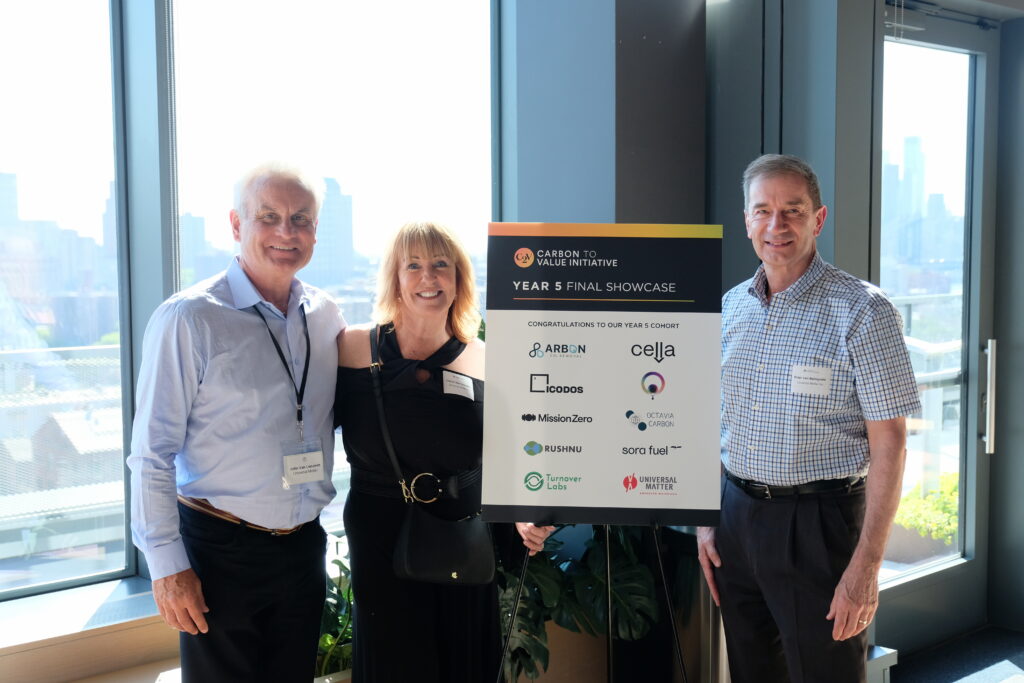
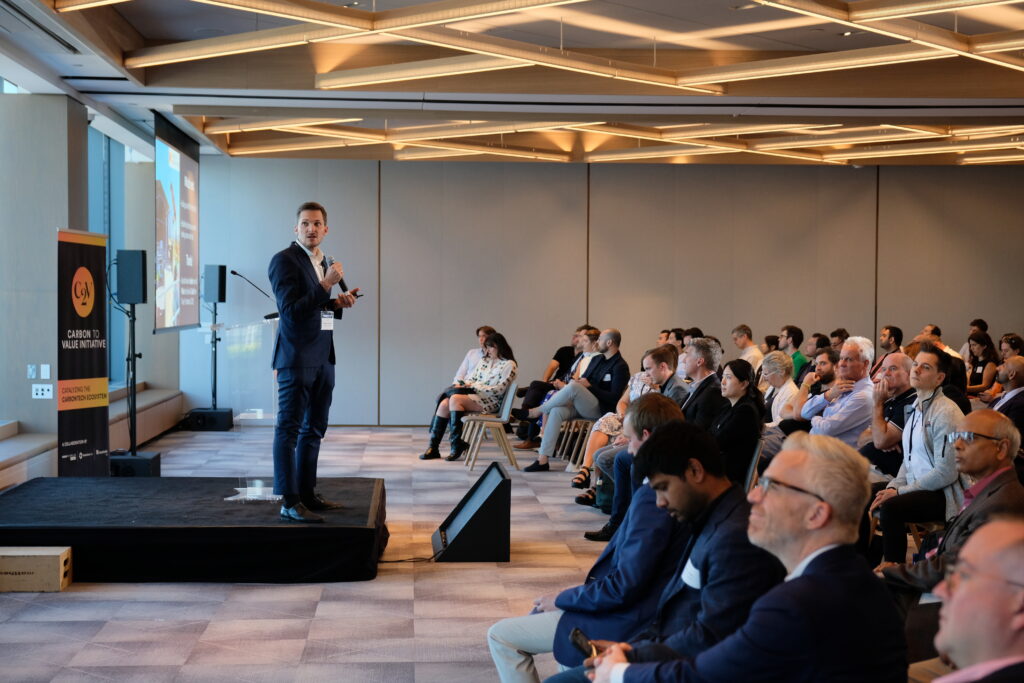
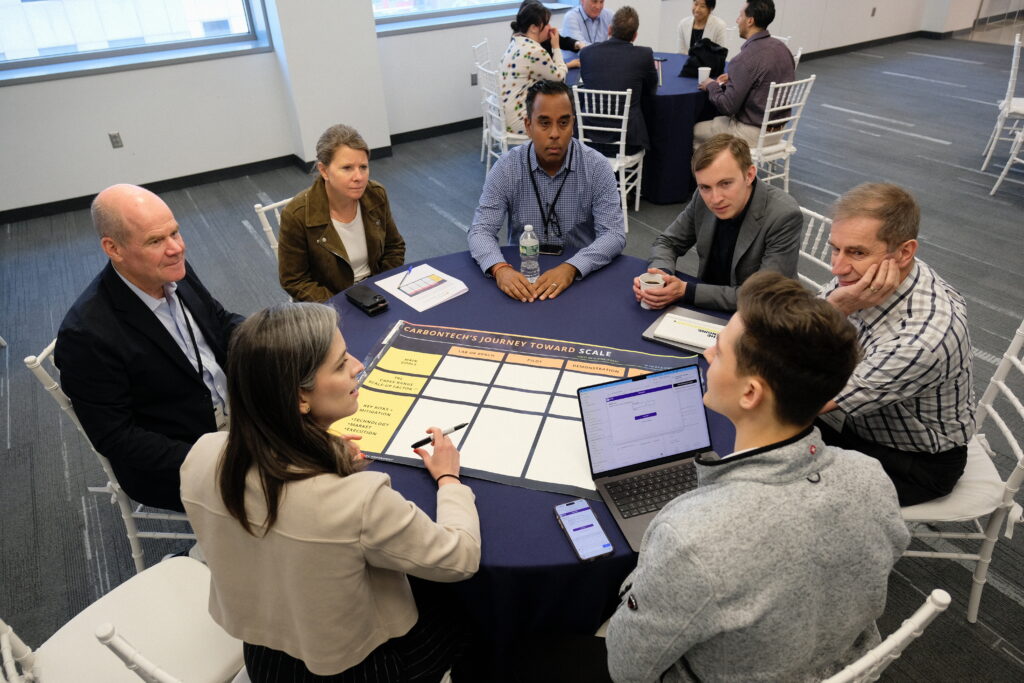
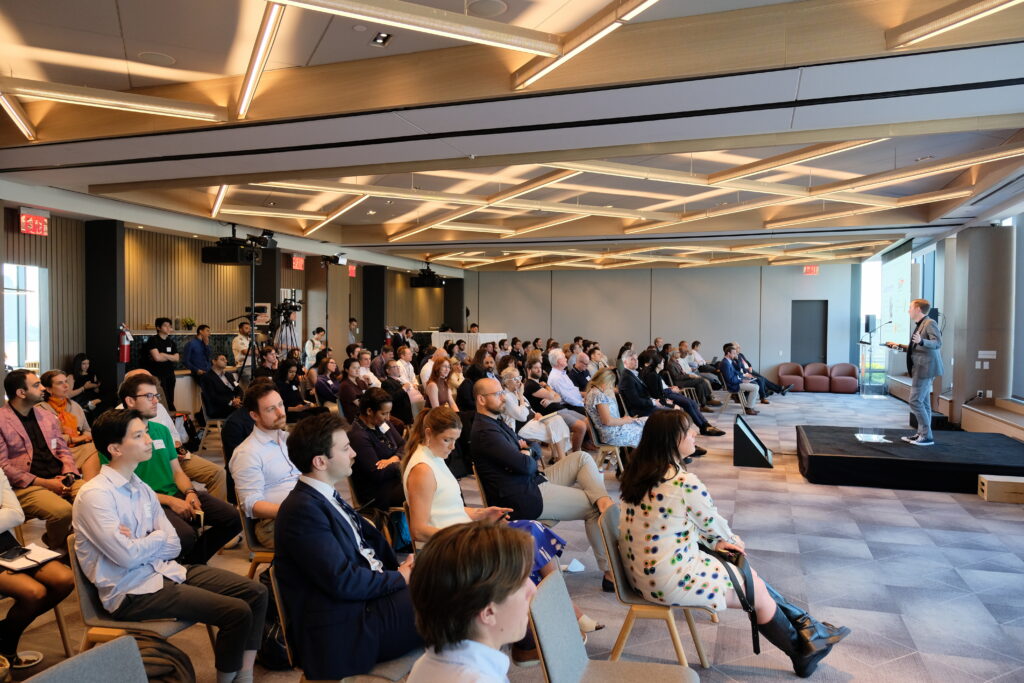
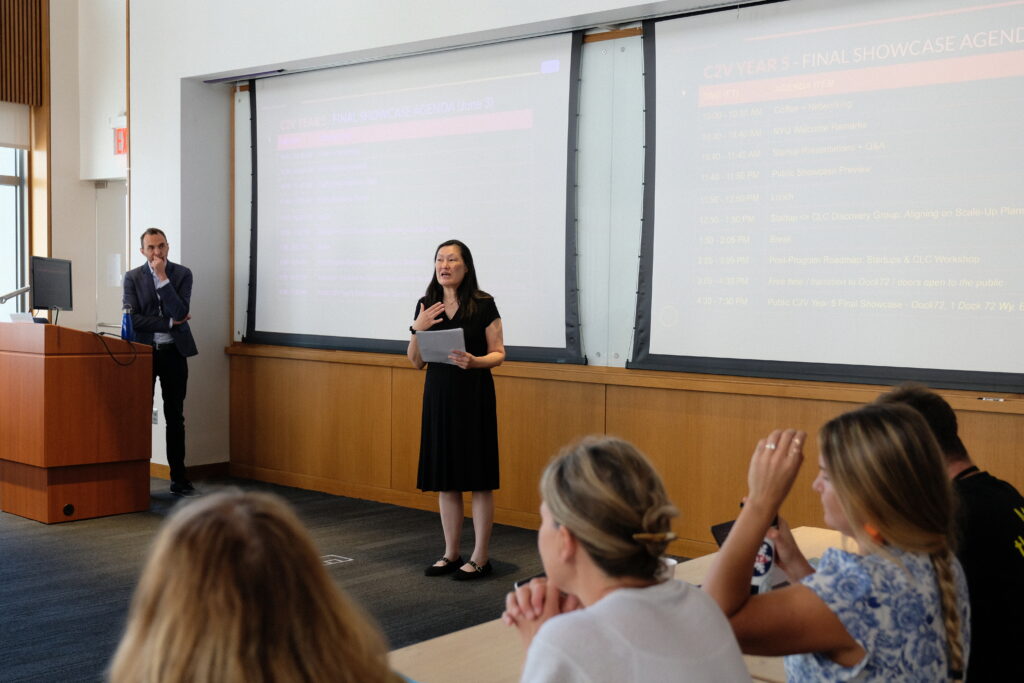
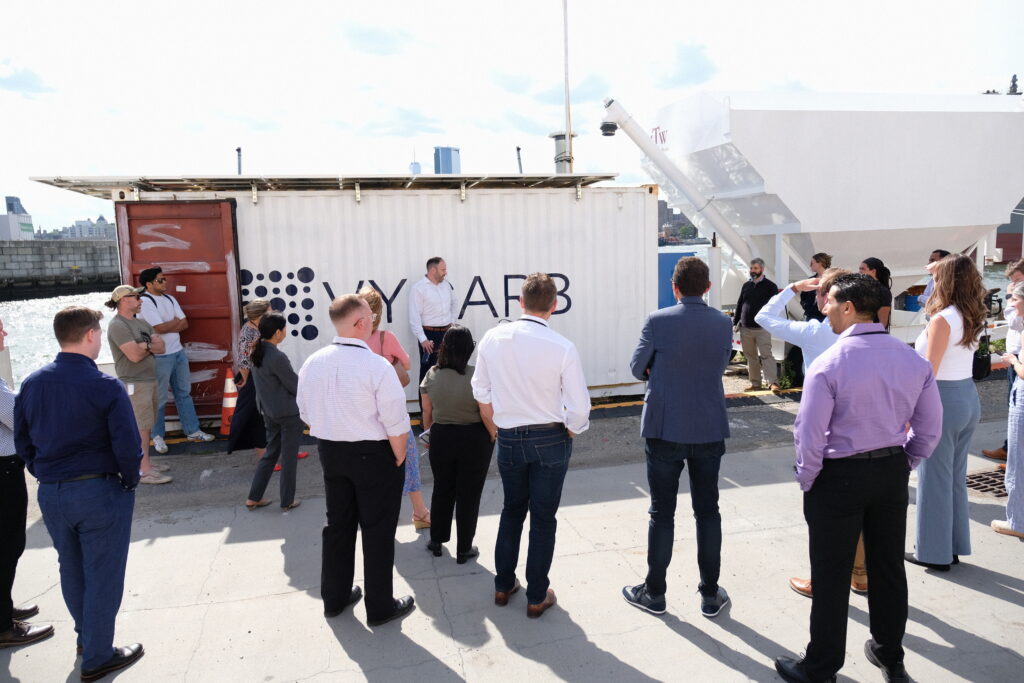
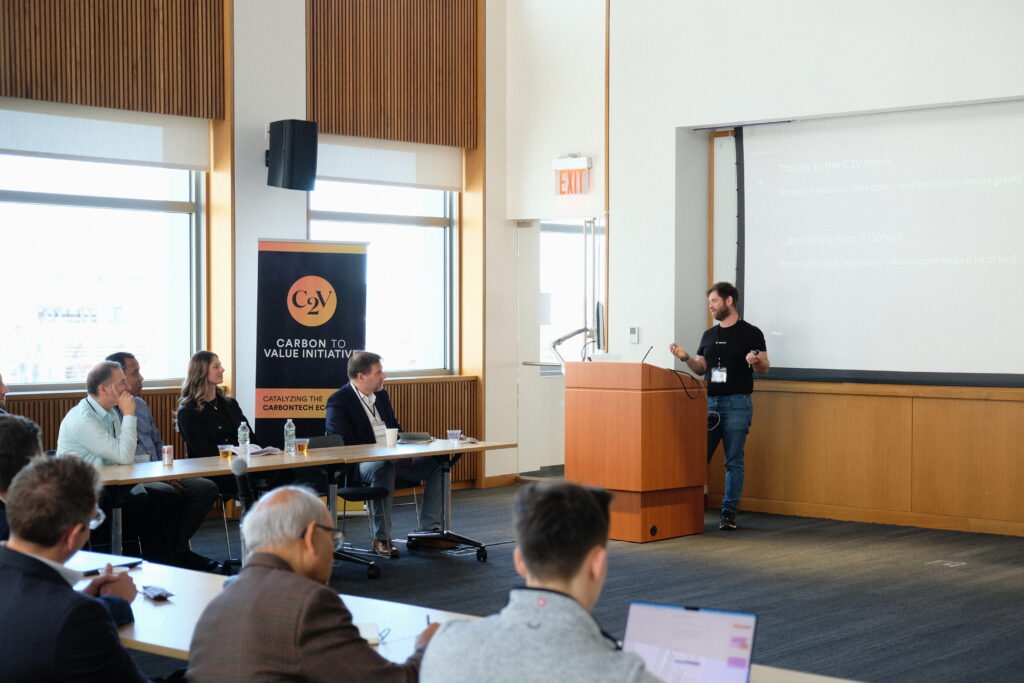
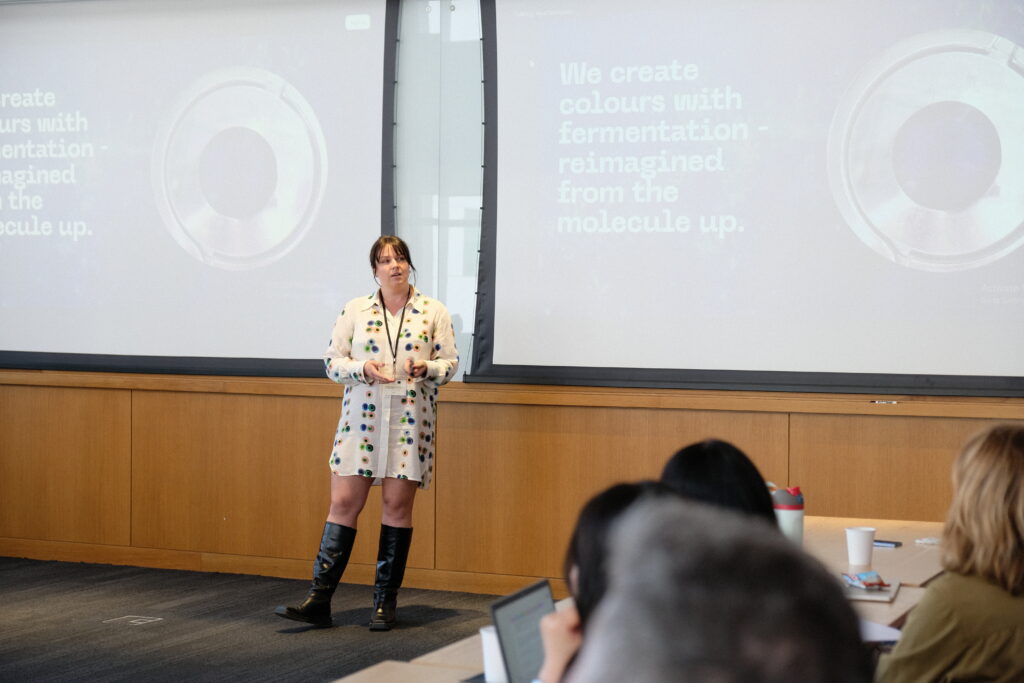
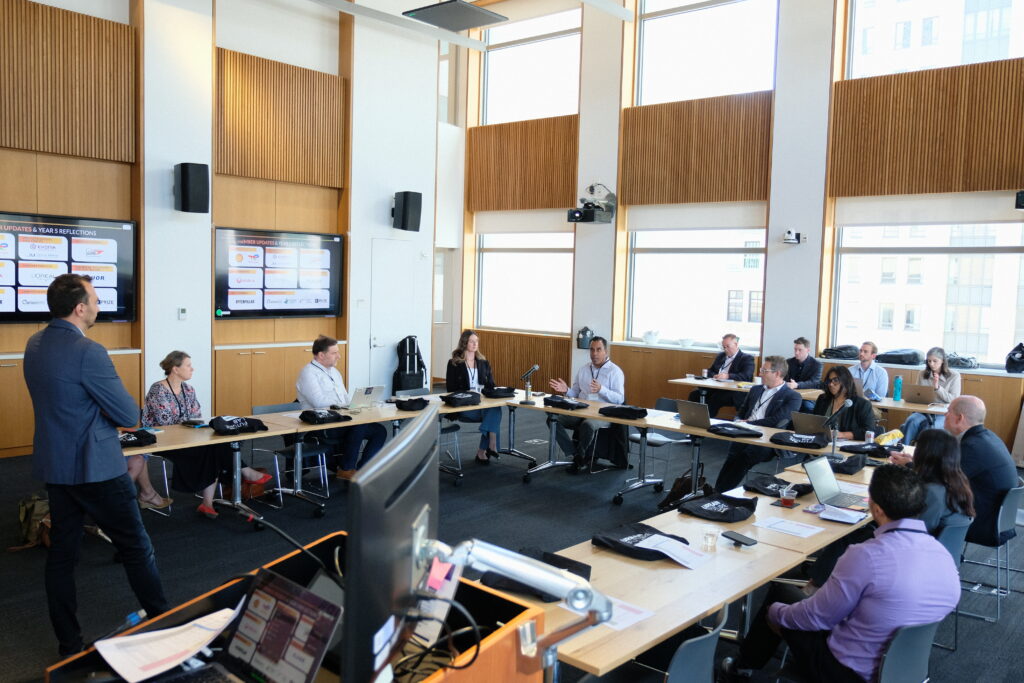
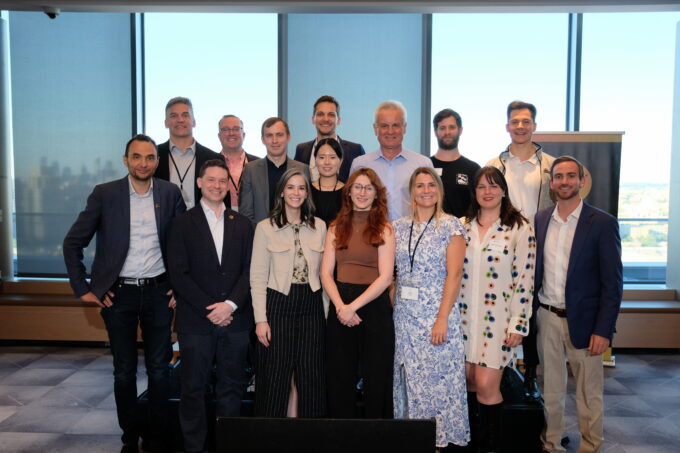
Photos from C2V Year 5 Workshops, Site Visits, and Pitch and Networking Events in New York City